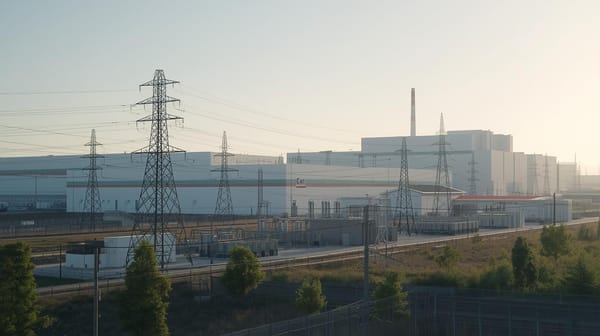
The 2026 Megaproject Leadership Index
Who will lead the next phase of the AI data center buildout? The 2026 Megaproject Leadership Index ranks the developers best positioned to deliver gigawatt-scale campuses amid power constraints, supply chain volatility, and rising hyperscale demand.


Which Data Center Developers Are Best Positioned for the AI Buildout?
Executive Summary
The data center sector has entered the gigawatt era.
Demand is no longer measured in megawatts — it is measured in multi-GW campuses, AI-ready cooling systems, and the ability to bring power online faster than competitors.
In this environment, capital alone is no longer the differentiator.
The winners of 2026 will be defined by:
- how quickly they can secure and deliver power
- how well they can navigate long-lead equipment volatility
- how reliably they can build through constraints
- and how deeply they are embedded with hyperscale partners
The 2026 Megaproject Leadership Index ranks developers by their ability to execute through these constraints. While many firms are expanding, a smaller group stands out as structurally advantaged for the next phase of the AI buildout.
The Six Factors That Determine 2026 Leadership
These criteria define who can compete — and who cannot — in the multi-GW market that hyperscalers now expect.
1. Power Acquisition Strategy
The #1 bottleneck — and the #1 differentiator.
Winners have:
- direct utility partnerships
- substation acceleration programs
- land chosen for transmission access
- on-site generation optionality
- early interconnection positioning
Power = schedule.
Schedule = revenue.
Developers who can deliver power fastest win the next cycle.
2. Supply Chain Elasticity
Transformer, switchgear, and MV gear delays remain the most underestimated risk in megaproject sequencing.
Top developers show:
- OFCI discipline
- long-term procurement partnerships
- diversified supplier ecosystems
- predictable commissioning dependencies
Supply chain flexibility is now a strategic capability, not an operational detail.
3. Execution Velocity
Delivery speed — especially predictable delivery speed — is the currency hyperscalers trust.
Leaders consistently:
- build standardized, repeatable campuses
- hit commissioning dates
- reduce schedule volatility
- maintain sequencing flow despite long-lead uncertainty
Execution velocity compounds over time.
4. Capital Positioning
In the age of private credit and multi-billion-dollar refinancings, developers must have:
- balance sheet strength
- flexible financing
- low-cost capital access
- the ability to scale simultaneous builds
The firms with the deepest capital efficiency are insulated from macro shocks.
5. Hyperscale Alignment
Hyperscalers reward:
- predictable delivery
- scalable design
- multi-market capability
- single-counterparty efficiency
Deep, multi-GW commitments will define the leaders of 2026.
6. Strategic Optionality
Winning developers move early and adjust fast.
Optionality includes:
- land banks in defensible regions
- market pivot ability
- regulatory navigation
- cooling and density flexibility
- renewable and gas-hybrid power strategies
Optionality = resilience.
The 2026 Megaproject Leadership Index
Ranking the Developers Best Positioned for the AI Buildout
1. Vantage Data Centers — The Scaling Specialist
Vantage enters 2026 with rare alignment across all six leadership criteria. Already delivering multi-GW campuses with standardized design, Vantage combines:
- high execution velocity
- strong utility partnerships
- hyperscale intimacy
- aggressive land and power strategy
- campus repeatability at scale
Few developers offer both the speed and the scalability hyperscalers now require. Vantage is positioned not just to compete — but to lead the cycle.
2. QTS (Blackstone) — The Capital Supercharger
QTS pairs operational execution with Blackstone’s unparalleled capital engine. Recent refinancings — including a $3.5B CMBS note — reflect a balance sheet designed for massive, simultaneous builds.
Advantages:
- capital flexibility
- multi-market expansion velocity
- hyperscale trust built on consistent delivery
- Blackstone’s private credit access
QTS may be the best-capitalized developer in the sector — a decisive advantage in the 2026 megaproject environment.
3. NTT — The Global Platform With Rising U.S. Momentum
NTT’s global footprint is now translating into serious U.S. scale.
Strengths:
- disciplined global supply chain leverage
- standardized megacampus design
- strong utilities relationships
- growing U.S. market share
NTT is shifting from a global operator to a U.S. megaproject contender.
4. Equinix — The Institutional Stabilizer
Equinix may not chase the fastest 1-GW builds, but its interconnection moat remains unmatched. With xScale expanding and capital markets confidence high, Equinix continues to execute on long-term, resilient growth.
Strengths:
- predictable delivery
- unparalleled network effects
- strong balance sheet
- deep enterprise and cloud alignment
A stable, durable megaproject player.
5. Digital Realty — The Portfolio Transformer
Digital Realty is navigating one of its most pivotal moments — and doing so with strategic intent. Portfolio optimization, asset sales, and reinvestment into hyperscale-ready markets position DLR for a meaningful 2026 pivot.
Strengths:
- global diversification
- hyperscale familiarity
- emerging campus strategy
- strong refinancing posture
2026 could be the year Digital’s strategy fully realigns with AI-driven demand.
6. STACK Infrastructure — The Pure Hyperscale Machine
STACK continues to show remarkable execution consistency across:
- multi-phase builds
- multi-regional capability
- hyperscale responsiveness
STACK is a favorite for hyperscalers who value velocity + trust.
7. Compass Datacenters — The Modular Execution Specialist
Compass’s modular frameworks remain one of the best tools for predictable project sequencing. Its disciplined procurement and repeatable designs reduce schedule risk across markets.
Strengths:
- standardized build approach
- strong leadership team
- reliable commissioning performance
A developer with structural advantages in repeatable delivery.
8. Aligned — Density Meets Agility
Aligned’s cooling and density strategy gives it meaningful leverage in AI-era deployments.
Strengths:
- adaptive cooling
- strong private equity backing
- strategic regional growth
Aligned enters 2026 with unique technical advantages.
9. Sabey — The Quiet Operator With Strong Fundamentals
Sabey’s disciplined, patient approach gives it stability others lack.
Strengths:
- selective high-quality markets
- long-term utility partnerships
- predictable delivery
A smaller portfolio, but a strong one.
10. Regional Specialists: EdgeConneX, Skybox, Prime
These firms excel in regional dominance, land strategy, and fast market entry — but lack the scale of top-tier megacampus developers.
Strengths:
- rapid permitting
- strong local utility relationships
- competitive agility
Strong regional players with upward potential.
What Separates the Top 3 From the Pack
Across the top of the Index, three themes emerge:
1. Power Is the Real Moat
Developers who can secure, sequence, and energize power fastest are the only ones who can deliver multi-GW campuses on hyperscale timelines.
2. Lead-Time Reliability Has Become Strategic
Long-lead electrical gear — transformers, switchgear, MV equipment — now determines campus timelines.
Supply chain elasticity is becoming a core differentiator.
3. Execution Velocity Compounds
Developers who deliver consistently gain hyperscale trust — which creates more pipeline, more scale, and more efficiency.
This compounding effect is why the gap between leaders and followers is widening.
Five Predictions for 2026
- Private credit becomes the megaproject financing norm.
- Transformer supply becomes a defining competitive advantage.
- Tier II markets outgrow Tier I as grid constraints deepen.
- On-site generation emerges as the next developer arms race.
- A “megacampus premium” emerges — bundling land, power, and zoning into singular growth packages.
Closing Insight
The next phase of the AI buildout will not be won by the developers with the most land — or even the most capital.
It will be won by those who can execute through constraints:
- acquiring power faster
- stabilizing schedules
- navigating supply chain volatility
- delivering predictable megacampus performance
In 2026, execution is strategy — and the developers ranked here are the ones most structurally positioned to win.
To receive weekly analysis on the power, policy, and capital forces shaping the data center industry, subscribe to The Datacenter Economist.